
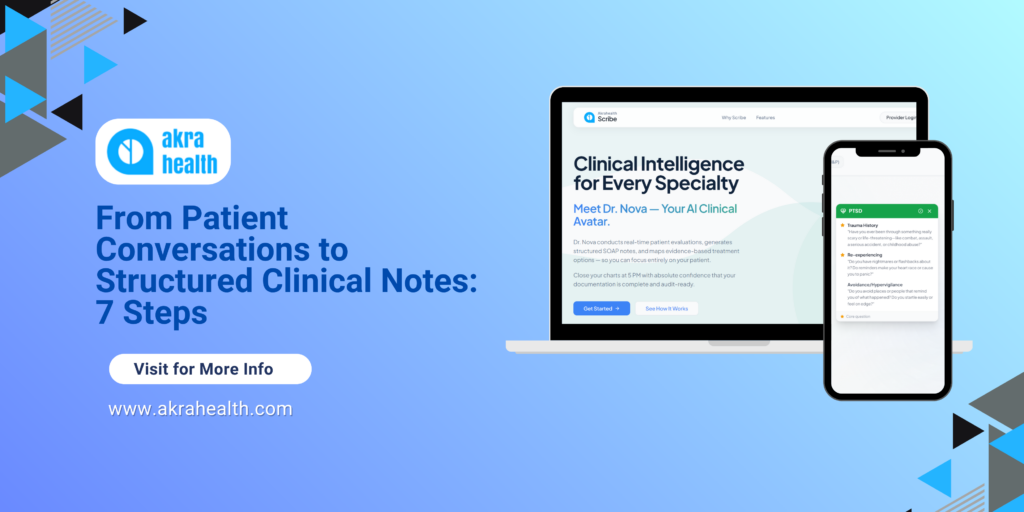
AI Medical Documentation: 7 Steps to Clinical Notes
A doctor’s consultation involves more than asking questions and recommending treatment. During a visit, clinicians may discuss symptoms, medical history, medications, allergies, examination findings, and follow-up plans. Capturing all this information accurately while maintaining a natural conversation can be challenging.
AI medical documentation offers a way to simplify this process. With appropriate tools, AI can help transform a doctor-patient conversation into a structured clinical note, giving clinicians a draft they can review and edit instead of starting every note from scratch.
This process is often associated with AI-powered clinical documentation and ambient documentation tools. Depending on the system, the technology may use speech recognition, language processing, and clinical templates to organize information from a consultation.
But how does a conversation become a structured note? Here are seven steps that explain the process, its potential benefits, and the safeguards healthcare practices should consider.
1. Capture the Patient Conversation
The process begins during the consultation.
With an appropriate AI documentation tool, a clinician can capture a patient conversation using an authorized recording or audio-capture workflow. Some tools are designed to operate in the background, allowing the clinician to focus on the patient rather than continuously typing notes.
For example, a patient may describe recurring headaches, explain when the symptoms started, and mention medication they have already tried. The clinician may ask follow-up questions and discuss possible next steps.
The AI system uses the captured conversation as the source material for documentation.
Why it matters: Clinicians can potentially spend less time typing during the consultation and more time engaging with the patient.
Recording and transcription should take place only under the applicable consent, privacy, and organizational requirements. Practices should also explain how patient information will be handled.
2. Convert Speech Into Text
Once the conversation has been captured, speech recognition technology can convert spoken words into text.
This step is important because everyday conversations rarely follow the format of a medical record. Patients may pause, repeat themselves, describe symptoms informally, or move between different topics.
For example, a patient might say:
“I’ve had this cough for about a week. It gets worse at night, and I’ve been feeling tired.”
Speech recognition can turn those spoken words into a written transcript for further processing.
However, transcription is not always perfect. Background noise, accents, medical terminology, overlapping speech, and unclear pronunciation can affect accuracy.
Why it matters: A written transcript provides the source material that the system can organize into a more readable clinical note.
Clinicians should verify important details, particularly medication names, dosages, allergies, dates, and other information that could affect patient care.
3. Identify Clinically Relevant Information
A transcript may contain useful clinical details alongside casual conversation, repeated phrases, and unrelated comments.
AI language-processing systems can help identify information relevant to the clinical encounter, depending on their capabilities and configuration.
This may include:
- The patient’s reported symptoms
- When symptoms started and how they have changed
- Relevant medical history
- Medications and allergies discussed
- Questions asked by the clinician
- Examination findings stated during the consultation
- Assessment and follow-up plans discussed
For example, a conversation about a cough may contain details about its duration, severity, associated symptoms, and previous treatment. The system can help organize these details so they are easier to review.
The important distinction is that organizing information is not the same as verifying it. AI should not be assumed to know whether every statement is correct or clinically significant.
Why it matters: Identifying relevant information can help reduce the effort involved in turning an unstructured conversation into usable documentation.
4. Organize Information Into a Structured Clinical Note
After identifying relevant details, the AI system can organize them into a format selected by the clinician or practice.
One commonly used format is the SOAP note.
SOAP stands for:
- S — Subjective: Symptoms and information reported by the patient.
- O — Objective: Measurable or observable findings, such as examination results and vital signs.
- A — Assessment: The clinician’s assessment of the patient’s condition.
- P — Plan: The proposed treatment, investigations, advice, or follow-up.
Consider the earlier example of a patient describing a cough.
The system might place the reported duration and symptoms under the subjective section. Objective findings should come from documented observations or other verified clinical data, not be invented from the conversation.
The assessment and plan must reflect the clinician’s actual evaluation and decisions. AI should not fill gaps by creating findings, diagnoses, or treatment instructions that were never established.
Why it matters: A structured format makes clinical notes easier to read, review, and incorporate into the practice’s documentation workflow.
5. Generate a Readable Draft
A raw transcript can be lengthy and difficult to scan. The next step is to turn the organized information into a clear clinical note.
Depending on the system, this may involve removing unnecessary repetition, improving sentence structure, grouping related information, and applying a suitable documentation template.
For instance, instead of reproducing every sentence from a conversation, the draft may summarize the patient’s reported symptoms and relevant history in a concise format.
The goal is not to make the note sound impressive or unnecessarily complex. It is to preserve the meaning of the conversation while making the information easier for a clinician to review.
This is where AI-powered clinical note generation can be useful: it can help produce a first draft that follows the practice’s preferred structure.
However, a polished note can still contain mistakes. Clear writing should never be treated as proof of clinical accuracy.
6. Review and Correct the Note
Clinician review is one of the most important steps in the process.
AI-generated notes can contain transcription errors, omit relevant details, misinterpret statements, or incorrectly associate information with a patient. They may also present uncertain information too confidently.
Before finalizing a note, the clinician should check that:
- Symptoms and medical history are represented accurately.
- Medication names and dosages are correct.
- Allergies and relevant safety information are included appropriately.
- Examination findings have not been invented.
- The assessment reflects the clinician’s judgment.
- The plan accurately reflects the decisions made during the consultation.
- No unrelated or incorrect information has been added.
Any errors or missing details should be corrected before the note becomes part of the official medical record.
Why it matters: AI can assist with documentation, but the clinician remains responsible for reviewing the record and ensuring that it accurately represents the encounter.
7. Add the Approved Note to the Clinical Workflow
Once reviewed and approved, the clinical note can be incorporated into the practice’s documentation process.
Depending on the available features, the system may allow the note to be copied into an electronic medical record, transferred through an integration, or saved using a supported workflow.
Practices should confirm how the tool handles note approval, record updates, access permissions, and audit trails before using it in routine care.
The aim is to avoid creating another disconnected step. If clinicians must repeatedly copy information between systems, some of the time saved during drafting may be lost.
When documentation tools work appropriately with the wider EMR workflow, practices can create a more consistent process from consultation to record completion.
Benefits of Turning Patient Conversations Into Structured Notes
When implemented carefully, AI-assisted documentation can offer several practical advantages.
Less manual typing
A draft created from a consultation can reduce the amount of information clinicians need to enter manually. The actual time saved depends on the workflow, the quality of the output, and how much editing is required.
More consistent documentation
Templates can help clinicians follow a standard note structure, making records easier to review across visits.
Better organization of information
Grouping symptoms, history, findings, and plans into appropriate sections can make notes easier to navigate.
More attention during consultations
Reducing the need to type continuously may help clinicians maintain better engagement with patients, although the benefit depends on how the tool is used.
Support for documentation workflows
AI-generated drafts may help practices manage documentation tasks more efficiently when they are integrated into existing systems.
These benefits are not automatic. Results depend on transcription quality, system configuration, clinician review, staff training, and how well the technology fits the practice’s workflow.
What Healthcare Practices Should Consider Before Using AI Documentation
Before introducing an AI documentation tool, practices should evaluate more than its ability to generate a note.
Accuracy: Test the system with realistic consultations and review how it handles medical terminology, accents, and complex conversations.
Privacy and security: Understand how audio, transcripts, and generated notes are processed, stored, accessed, and retained. Review applicable HIPAA obligations and vendor agreements where relevant.
Consent: Establish an appropriate process for informing patients and obtaining consent when required by law or organizational policy.
EMR compatibility: Confirm whether the system integrates with the existing electronic medical record and which functions are supported.
Clinician oversight: Ensure clinicians can review, edit, and approve notes before they become part of the official record.
Transparency: Staff should understand the system’s limitations and know when manual documentation or additional verification is necessary.
A careful implementation helps practices evaluate whether the technology genuinely improves their documentation process rather than simply adding another tool.
How AkraHealth Fits Into AI-Assisted Clinical Documentation
AkraHealth offers healthcare technology designed to support clinical documentation and practice workflows. Its AI Medical Scribe offering is relevant to practices exploring ways to reduce manual documentation work.
In an AI-assisted documentation workflow, the objective is to help transform a consultation into an organized draft that clinicians can review and refine.
The broader goal is to make documentation more manageable while keeping clinical judgment and approval with the healthcare professional.
Practices considering AI documentation should evaluate the specific product’s capabilities, supported integrations, privacy safeguards, and review process to determine how it fits their needs.
Conclusion
Turning a patient conversation into a structured clinical note involves several steps: capturing the conversation, converting speech into text, identifying relevant information, organizing the content, generating a draft, reviewing it, and incorporating the approved note into the clinical workflow.
AI can help reduce repetitive documentation tasks and make clinical notes easier to organize. However, accurate documentation still depends on appropriate safeguards and clinician oversight.
For healthcare practices exploring AI-assisted documentation, the priority should be a workflow that saves effort without sacrificing accuracy, patient privacy, or the quality of the medical record.
Frequently Asked Questions
How does AI turn a patient conversation into a clinical note?
AI documentation tools can use speech recognition to transcribe a consultation and language-processing technology to organize relevant information into a structured note. A clinician then reviews and corrects the draft before approval.
What is a structured clinical note?
A structured clinical note organizes information from a patient encounter into defined sections. One common format is SOAP: Subjective, Objective, Assessment, and Plan.
Can AI generate SOAP notes automatically?
Some AI documentation tools can generate draft SOAP notes from consultation transcripts. The output must be checked to ensure it accurately reflects the patient’s statements, documented findings, and the clinician’s assessment and plan.
Does AI replace medical scribes or clinicians?
AI can assist with certain documentation tasks, but it does not replace clinical judgment or responsibility for the medical record. Practices should determine how AI fits into their workflow and which tasks still require human review.
Is AI-generated clinical documentation accurate?
Accuracy varies by system and use case. Transcription errors, missing details, and incorrect interpretations can occur, so clinicians should review generated notes before finalizing them.
Can AI-generated notes be added to an EMR?
Some systems support EMR integrations, while others require manual transfer or use a different workflow. Practices should confirm the exact integration and approval capabilities before implementation.